
How to Budget with Irregular Income: Top Proven Suggestions From Experts
About How to Budget with Irregular Income: Top Proven Suggestions From Experts
When your income changes from month to month, managing money can feel like a constant guessing game. One month, you may have more than enough to cover your bills; the next, you may be waiting for an invoice, commission, or client payment.
The good news is that an irregular paycheck does not make financial stability impossible. The right irregular income budget gives every dollar a job, protects you during slow periods, and helps you use high-income months wisely.
Federal Reserve Report on the Economic Well-Being of U.S. Households says that 29% of adults had income that varied at least occasionally from month to month in 2024.
Americans say that if you have an irregular income, budgeting won’t work for you. That’s totally not true; this guide explains how to budget with irregular income, prepare for taxes and unexpected expenses, build a cash buffer, manage debt, and invest when your earnings are unpredictable.
What Is Irregular Income and Examples?
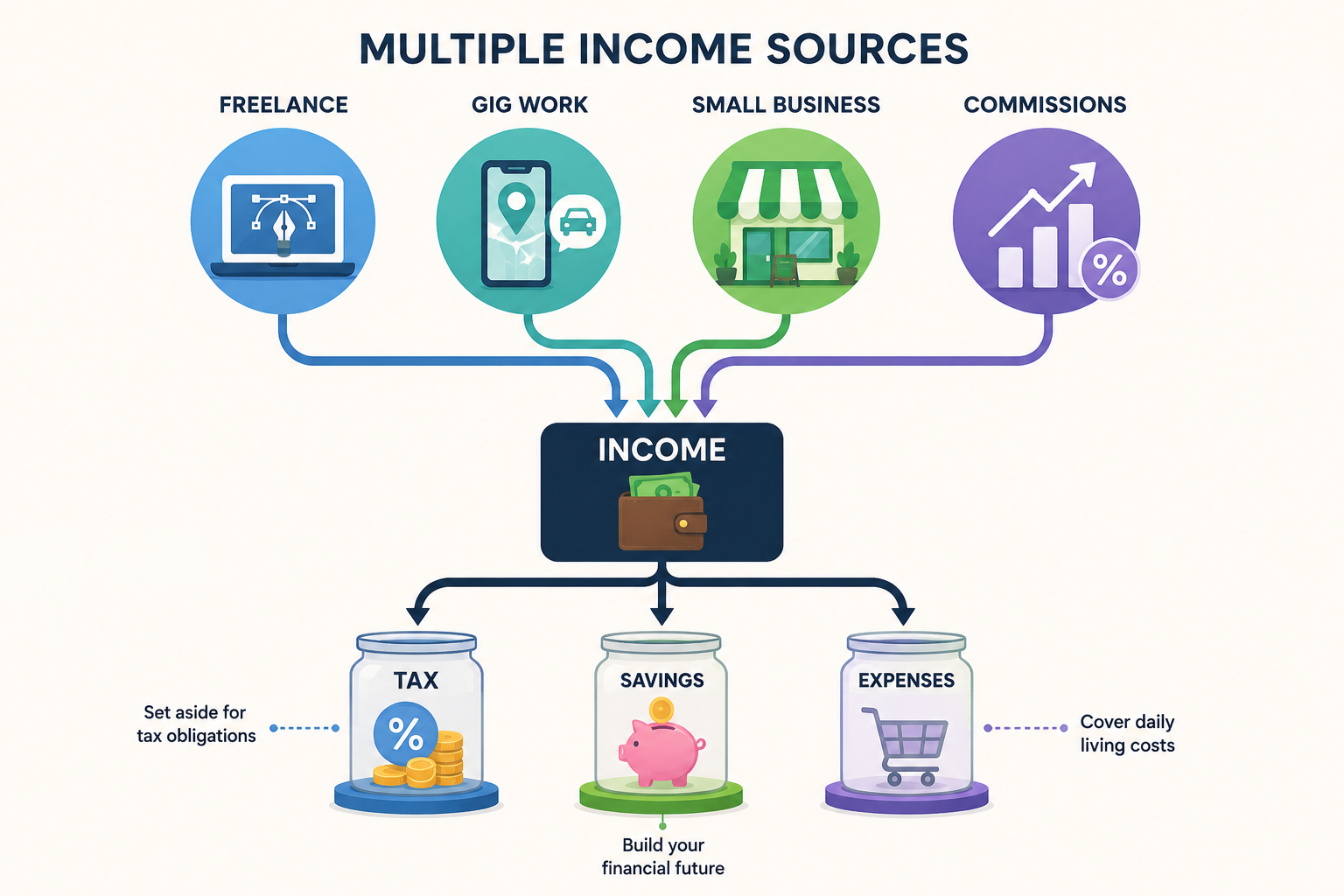
Irregular income is money that does not arrive in the same amount or on the same schedule every pay period. You may earn a different amount each month, receive several payments at once, or experience seasonal changes in your work. Such irregular income includes:
- Freelance or contract income.
- Commission-based pay.
- Gig work and tips.
- Small-business revenue.
- Real estate commissions.
- Seasonal employment.
- Bonuses and performance-based compensation.
- Income from multiple clients or side hustles.
Traditional budgets often assume that you receive a predictable paycheck twice a month. An irregular income budget works differently: it focuses on your lowest reliable income, payment timing, cash reserves, and spending priorities.
Does Budgeting Work with Irregular Income?
Some people say, “If you have an irregular income, budgeting won’t work for you.” That is usually not true. A rigid budget may fail when your earnings fluctuate, but a flexible cash-flow system can work very well.

Instead of asking, “How much can I spend this month?” ask:
- What is the lowest amount I can reasonably expect to earn?
- Which expenses must be paid first?
- When will money arrive?
- How much should remain available for future months?
- What should happen to income above my baseline?
This approach changes your budget from a fixed prediction into a decision-making system.
Step 1: Track Your Income and Expenses
Before creating a budget, understand how money moves through your household.
Review your bank accounts, invoices, payment apps, tax records, and credit-card statements. If possible, look back over the previous 6 to 12 months.
Record:
- The amount you earned each month.
- The date each payment arrived.
- Your essential expenses.
- Your flexible spending.
- Annual and occasional bills.
- Taxes and business costs.
- Amounts saved or invested.
Do not rely only on your average income. An average can hide the fact that your lowest months may not cover your bills.
Tracking the low and high points gives you a more realistic picture of your cash flow.
Step 2: Find Your Income Floor
Your income floor is the conservative amount you can reasonably expect during a normal low-income month.
There are several ways to calculate it:
- Use your lowest consistent monthly income.
- Review your lowest three months from the past year.
- Use a conservative average if your lowest month was unusual.
- If you are new to freelancing, estimate cautiously rather than using your best projection.
For example, suppose your income over six months was:
- $2,700
- $3,100
- $3,800
- $4,400
- $2,900
- $5,000
You may decide to build your core budget around $2,700 to $3,000, not $5,000.
Your income floor should ideally cover your necessary monthly expenses. Guidance on budgeting with variable income commonly recommends using the lowest reliable income or a conservative baseline rather than the highest-earning month.
Step 3: Separate Your Money into Accounts
A separate-account system can make unpredictable income easier to manage.
Consider using:
Income-holding account
Send client payments, commissions, and other irregular income here first. This account acts as a staging area instead of allowing every payment to flow directly into everyday spending.
Personal spending account
Transfer a planned amount from the holding account to cover your monthly expenses. This works like paying yourself a regular paycheck.
Tax savings account
Keep money for federal, state, and self-employment taxes separate from spending money.
Emergency or buffer account
Use this account for income gaps, urgent repairs, medical costs, or other unexpected needs.
Freelancers may also benefit from separating business and personal accounts. That makes it easier to track business expenses, estimate profit, and avoid spending money that belongs to the business or the IRS.
Step 4: Build a Three-Level Budget
Instead of treating every expense equally, divide spending into three levels.
Level 1: Essential expenses
These are the costs you need to protect first:
- Rent or mortgage.
- Utilities.
- Groceries.
- Transportation.
- Health insurance and medical care.
- Childcare.
- Minimum debt payments.
- Basic business expenses.
- Required insurance premiums.
Level 2: Financial priorities
These expenses help protect your future:
- Tax reserves.
- Emergency savings.
- Income-buffer savings.
- Retirement contributions.
- Sinking funds.
- Extra debt payments.
- Professional training or equipment.
Level 3: Flexible spending
These costs can usually be reduced or paused:
- Restaurants and takeout.
- Entertainment.
- Shopping.
- Travel.
- Extra subscriptions.
- Nonessential upgrades.
In a low-income month, fund Level 1 first. When income is shigher add money to Levels 2 and 3 without allowing lifestyle spending to permanently rise.
Step 5: Create a Cash-Flow Calendar
Your total monthly income is only part of the problem. Timing matters too.
You may earn $5,000 during a month but still struggle if your largest client does not pay until after rent, insurance, and utilities are due.
Create a calendar that shows:
- Expected payment dates.
- Invoice due dates.
- Rent or mortgage payments.
- Subscription renewals.
- Quarterly taxes.
- Insurance premiums.
- Annual expenses.
- Planned transfers to savings.
A cash-flow calendar can reveal upcoming shortages before they become emergencies. If a payment is likely to arrive late, you have time to reduce flexible spending, move money from a buffer, or contact a provider.
Also Check out: How Americans Can Build Financial Freedom: 25 Proven Money Habits That Actually Work
Step 6: Pay Yourself a Consistent Amount
When income arrives unpredictably, paying yourself a planned monthly amount can create stability.
For example, if your income floor is $3,200 and your essential expenses are $2,600, you might transfer $2,800 or $3,000 from your holding account each month. The remaining money stays available for taxes, slow periods, annual bills, and future goals.
This does not mean you are ignoring your actual income. It means you are smoothing the timing of your income instead of spending heavily whenever a large payment arrives.
Review your monthly “paycheck” every few months, not every time a client pays you. Frequent changes can make your spending just as unpredictable as your income.
Step 7: Plan for Low-Income Months
A strong irregular income budget includes a “lean-month plan” before you need it.
When income drops:
- Fund housing, utilities, food, transportation, and healthcare.
- Make minimum debt payments.
- Protect required insurance and business expenses.
- Pause or reduce flexible spending.
- Delay optional purchases.
- Use your income buffer if necessary.
- Contact lenders or service providers before missing a payment.
It is easier to make these decisions in advance than when a bill is already overdue.
You can also create two spending plans:
- Baseline budget: Your normal plan based on your income floor.
- Lean-month budget: A temporary plan that includes only essential expenses.
This gives you a clear response when work slows down instead of forcing you to make decisions under pressure.
Step 8: Use High-Income Months Wisely
A large payment can feel like a reward, especially after a difficult month. But the money may need to cover several future obligations.
When income is higher than your baseline, consider using it in this order:
- Cover upcoming essential expenses.
- Set aside estimated taxes.
- Rebuild your income buffer.
- Fund annual and irregular bills.
- Contribute to emergency savings.
- Pay down high-interest debt.
- Invest for longer-term goals.
- Spend a limited amount on something enjoyable.
A simple example allocation for surplus money might be:
- 40% for emergency savings or an income buffer.
- 25% for taxes and required obligations.
- 20% for debt or long-term goals.
- 15% for flexible spending.
These percentages are only an example. Your tax situation, debt interest rates, household expenses, and financial goals should determine your actual allocation.
Step 9: Create Sinking Funds
A sinking fund is money set aside gradually for a known future expense.
Common sinking funds include:
- Car repairs.
- Health insurance deductibles.
- Professional licenses.
- Holiday gifts.
- School expenses.
- Annual subscriptions.
- Home maintenance.
- Equipment replacement.
- Travel.
- Insurance renewals.
Use this calculation:
Monthly contribution = Expected expense/Months until payment = Money need to be saved
If your car insurance costs $1,200 every year, setting aside $100 per month is easier than finding $1,200 during the renewal month.
Sinking funds are especially useful for freelancers and business owners because irregular expenses can arrive during an already slow period.
Step 10: Save for Taxes
If you are a U.S. freelancer or independent contractor, your clients may not withhold taxes from your payments. You may need to pay federal income tax, state tax, and self-employment tax.
The IRS says self-employed people generally use estimated tax payments to pay income and self-employment taxes throughout the year. Independent contractors may also need to make quarterly estimated payments.
To prepare:
- Keep a separate tax savings account.
- Set aside money whenever you receive a payment.
- Track deductible business expenses carefully.
- Review your estimated tax position during the year.
- Use IRS guidance or consult a tax professional.
Do not automatically rely on a single tax percentage copied from another freelancer. The right amount depends on your income, deductions, filing status, state, and other household earnings.
Go through IRS Self-Employed Individuals Tax Center for estimated taxes, self-employment tax, deductions, and filing information.
Step 11: Build an Emergency and Income Buffer
An emergency fund and an income buffer are related but not identical.
An emergency fund covers unexpected expenses such as a medical bill, urgent repair, or family emergency.
An income buffer helps pay regular bills when a client payment is delayed or work temporarily slows.
Start with a realistic target:
- First, save one month of bare-bones expenses.
- Next, aim for several months of essential expenses.
Consider a larger reserve if your income is seasonal, client-dependent, or difficult to replace.
For example, if your essential expenses are $3,000 per month, a one-month buffer is $3,000. A three-month reserve would be $9,000.
Keep money needed soon in an accessible, relatively low-risk account. Do not place your emergency fund in investments that could lose value or be difficult to sell when you need the money.
Step 12: Manage Debt Carefully
Irregular income can make debt payments more stressful, but a clear order helps.
- Always prioritize required minimum payments.
- Avoid taking on new debt based on an unusually strong month.
- Keep a small cash buffer before making aggressive extra payments.
- Direct additional money toward high-interest debt when your reserves are adequate.
- Contact creditors early if you expect difficulty making a payment.
You can choose either:
- Debt avalanche: Pay extra toward the debt with the highest interest rate.
- Debt snowball: Pay extra toward the smallest balance first for quicker psychological wins.
The most important thing is choosing a method you can follow consistently.
Investment Options for Irregular Income Streams
You can invest with irregular income, but investing should come after your immediate financial obligations are under control.
Before investing, consider whether you have:
- Covered essential bills.
- Set aside tax money.
- Built an emergency or income buffer.
- Paid required debt payments.
- Identified the time frame for your goal.
Short-term money
Money needed within the next few months may be better suited to cash or cash-like options, such as:
- An FDIC-insured savings account.
- A high-yield savings account.
- A money market deposit account.
- Short-term Treasury bills.
According to TreasuryDirect, treasury bills are issued with terms ranging from four weeks to 52 weeks. Review liquidity, taxes, fees, and account protections before choosing an option.
Long-term money
For goals many years away, some people consider:
- An employer-sponsored retirement plan.
- An IRA.
- A diversified mutual fund.
- A diversified exchange-traded fund.
- A taxable brokerage account.
The right investment depends on your time horizon, risk tolerance, tax situation, and need for access. Avoid investing money that you may need for next month’s rent or taxes.
One practical approach is to invest a defined portion of income above your baseline rather than committing to a large fixed monthly contribution. For example, you might invest after funding your essentials, tax reserve, buffer, and planned expenses.
Irregular Income Budgeting Strategies for Freelancers
Freelancers often face both income volatility and business expenses. These strategies can help:
- Request deposits or milestone payments for larger projects.
- Set clear invoice due dates and late-payment terms.
- Track unpaid invoices separately from money already received.
- Keep business and personal accounts separate.
- Set aside money for software, equipment, insurance, and professional fees.
- Avoid treating an unpaid invoice as available income.
- Build multiple client or revenue sources where practical.
- Review your finances weekly during busy or uncertain periods.
- Keep a written minimum monthly income target.
A signed contract may improve payment clarity, but it cannot guarantee that every client will pay on time, your cash buffer remains important.
A Sample Irregular Income Budget
Here’s your monthly budget breakdown based on a $4,000 income floor:
| Category | Monthly Amount | % of Total |
|---|---|---|
| Housing and utilities | $1,600 | 40% |
| Food and transportation | $650 | 16.25% |
| Insurance and healthcare | $350 | 8.75% |
| Minimum debt payments | $250 | 6.25% |
| Tax reserve | $500 | 12.5% |
| Emergency/income buffer | $300 | 7.5% |
| Sinking funds | $200 | 5% |
| Flexible spending | $150 | 3.75% |
| Total | $4,000 | 100% |
If you earn $5,500 in a strong month, the extra $1,500 should not automatically become spending money.
You might use it for future taxes, savings, debt repayment, annual expenses, or a small planned purchase.
How Often Should You Review Your Budget?
A short weekly check-in can take only 10 minutes. Review:
- Money received.
- Invoices still unpaid.
- Bills due soon.
- Amount in your tax account.
- Amount in yo
- 3ur holding account.
- Upcoming annual expenses.
- Spending since the previous review.
Complete a deeper monthly review at the end of each month. Compare your actual income and expenses with your plan, then adjust the next month without abandoning the entire system.
Also Check out: The Complete Guide to Managing Personal Finances in the USA: Budgeting, Saving, Investing, and Building Long-Term Wealth
Property Details
Frequently Asked Questions
No FAQs added yet.