The Ultimate Emergency Fund Guide: How Much Money Should Every American Save?
About The Ultimate Emergency Fund Guide: How Much Money Should Every American Save?
If you’ve searched for this answer before, you’ve probably run into the same line over and over: “save three to six months of expenses.” It’s not wrong — but it’s not really an answer either. Three months for who? Six months of what expenses? Does it change if you’re self-employed, or a parent, or already have solid health insurance?
The truth is there’s no single number that applies to “every American,” because your job security, income type, household size, and safety net all change the math.
Bankrate’s Annual Emergency Savings Report 2026 says only 24% of Americans have no emergency savings at all.
This guide walks through exactly how to calculate your number — not a generic one — plus where to keep it, how it fits around debt payoff and retirement contributions, and what most guides leave out entirely: how unemployment benefits and insurance coverage should actually lower your target.
Quick answer
Most people need 3 to 6 months of essential expenses in cash. But your real number could be as low as 1 month (dual income, high job security, strong insurance) or as high as 12–24 months (retired, self-employed, single income, or in a high-risk field).
Step 1: Build the “starter fund” first
Before you aim for months of expenses, aim for a single milestone: $500–$1,000. This is the fund that stops a flat tire or a broken laptop from becoming credit card debt while you’re still working on the bigger goal.
Why this matters: Research from the Federal Reserve Bank of St. Louis found that even a small cash buffer — around $2,500 for lower-income households — dramatically reduces the odds that a financial shock will turn into a real crisis (e.g., skipped rent or missed medical care).
You don’t need six months of savings to get most of the protection. You need something between you and the first unexpected bill.
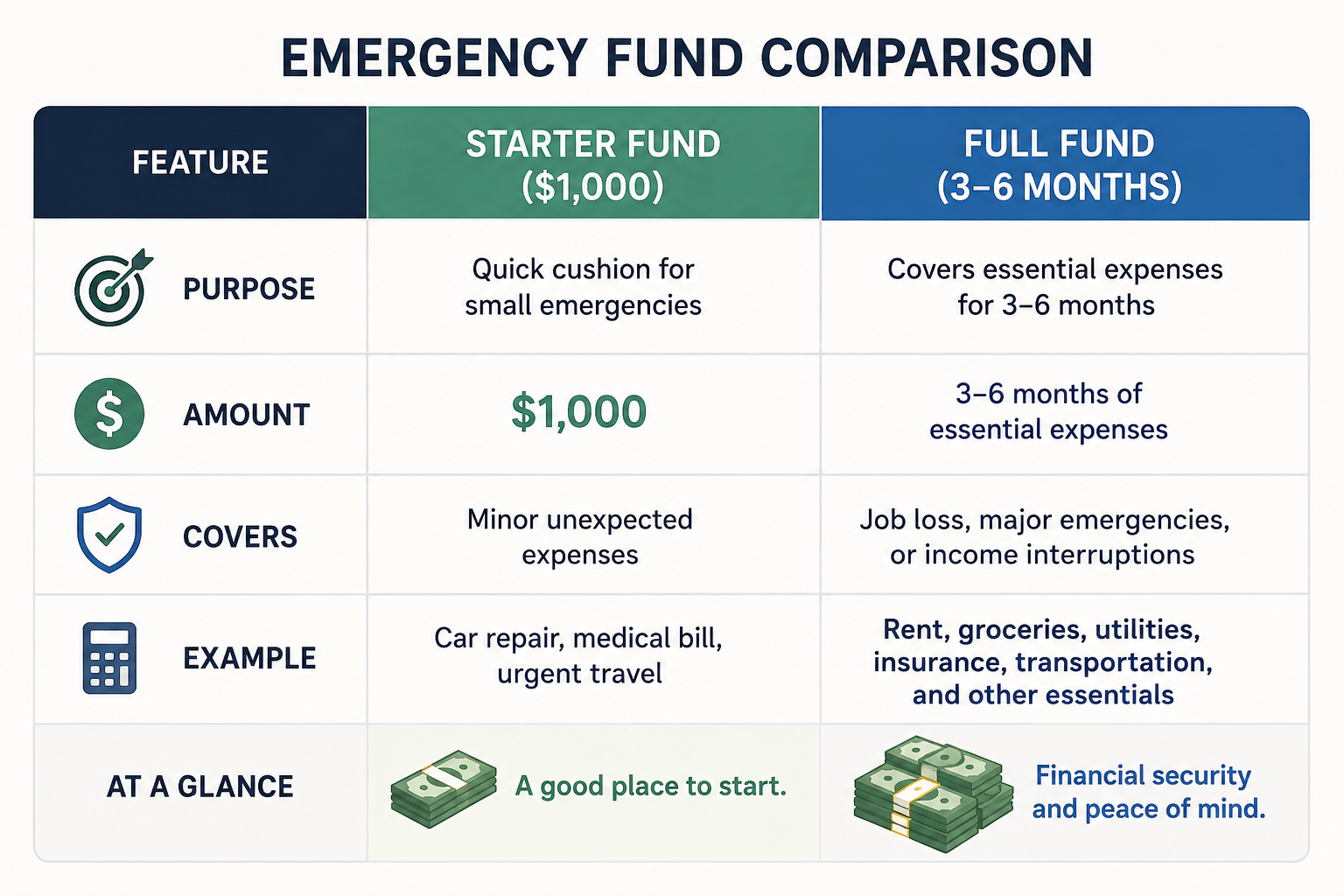
If you have high-interest debt (credit cards, payday loans): Build the $500–$1,000 starter fund first, then shift extra money to debt payoff, then come back and build the full fund once high-interest debt is gone. Paying off a 22% credit card is a guaranteed “return” that almost always beats sitting in cash.
If your employer offers a 401(k) match: Contribute enough to get the full match while building your starter fund — that match is free money and shouldn’t wait for a fully funded emergency account.
Once your starter fund and any high-interest debt are handled, come back and build out the full 3–6+ month cushion before increasing retirement contributions further.
Step 2: Find your real number — it’s not the same for everyone
This is the part every other emergency fund guide skips. “3 to 6 months” is a range because different people belong at different points on it — or outside it entirely.
| Your situation | Recommended cushion | Why |
| Dual-income household, both jobs stable | 3 months | A second income cushions a single job loss |
| Single income, no dependents | 4–5 months | One shock, no backup earner |
| Single income, with dependents | 6 months | Same risk, higher stakes |
| Freelancer / 1099 / commission-based income | 6–9 months | Income is irregular; “job loss” can be gradual and harder to define |
| Small business owner | 9–12 months | Business and personal cash flow are often linked |
| Retired or near-retiree | 12–24 months | Protects investments from being sold in a down market to cover living costs (sequence-of-returns risk) |
| Chronic health condition / high medical utilization | Add 1–3 months to your baseline | Predictable but variable annual costs beyond insurance |
| High-risk or cyclical industry (energy, tech layoffs, seasonal work) | Add 1–2 months to your baseline | Historically longer average job searches in these fields |
If more than one row applies to you (say, a freelancer with dependents), stack the reasoning and lean toward the higher end.
Also Check out: How Americans Can Build Financial Freedom: 25 Proven Money Habits That Actually Work
Step 3: Calculate your target number
The formula:
Monthly essential expenses × number of months you need = Your emergency fund target
“Essential” is the keyword. This is not your full monthly budget — it’s what you’d actually need to keep the lights on and food on the table if income stopped tomorrow.
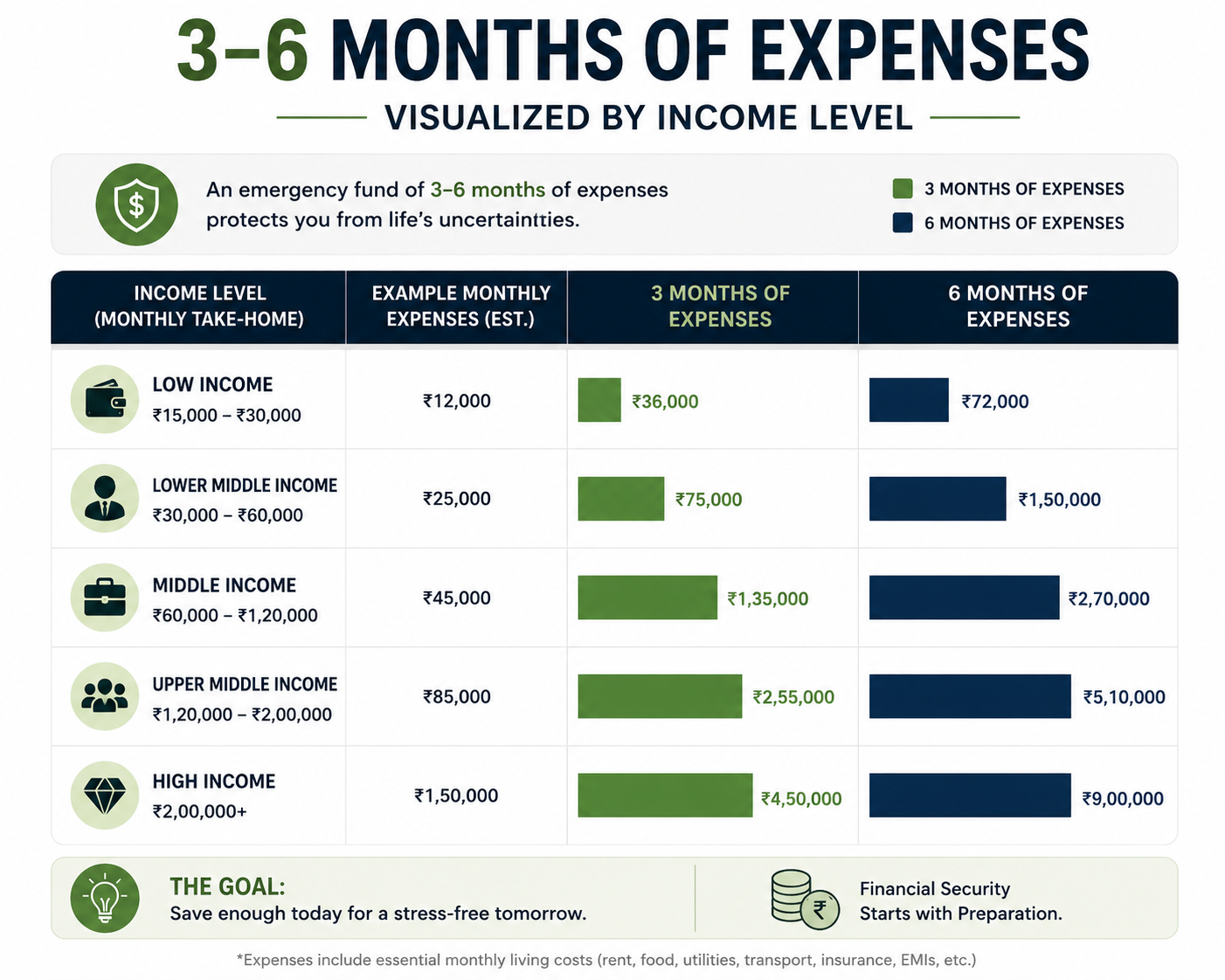
Essential expenses to include:
- Rent or mortgage
- Utilities (electric, gas, water, internet if needed for job search)
- Groceries
- Minimum debt payments
- Insurance premiums
- Transportation (car payment, gas, transit)
- Childcare, if it’s required for you to work or job search
Non-essential expenses to exclude:
- Dining out
- Subscriptions and streaming
- Hobbies, entertainment, travel
- Non-essential shopping
This distinction matters more than people think. If you normally spend $4,500/month but could realistically live on $3,000/month in a crisis, calculating “6 months of expenses” off the wrong number means the difference between a $27,000 goal and an $18,000 goal — a huge, avoidable gap.
Worked examples
Example 1 — Single renter, stable job, no dependents. Essential expenses: $2,400/month → Target range (3 months): $7,200
Example 2 — Dual-income couple with one child. Essential expenses: $4,800/month → Target range (4–5 months): $19,200–$24,000
Example 3 — Freelance graphic designer, single. Essential expenses: $3,000/month → Target range (6–9 months): $18,000–$27,000
Example 4 — Retiree, homeowner, on fixed income. Essential expenses: $3,500/month → Target range (12–24 months): $42,000–$84,000 (often split between a cash cushion and short-term, low-risk investments)
Where to actually keep your Emergency Fund?
Your fund needs to be liquid (accessible within a day or two, no penalty) and separate from your everyday spending account so you’re not tempted to dip into it.
| Account type | Pros | Cons |
| High-yield savings account (HYSA) | Easy access, earns meaningful interest, FDIC insured up to $250,000 | Rates can fluctuate |
| Money market account | Similar to HYSA, sometimes check-writing access | May require a minimum balance |
| CD (certificate of deposit) | Locked-in rate, sometimes higher than HYSA | Early withdrawal penalty — not ideal for your entire fund |
| Regular checking account | Instant access | Usually little or no interest |
| Cash at home | Zero delay, works if banking system is disrupted | No interest, theft/loss risk, easy to “borrow” from casually. |
According to a U.S. News survey, 65% of Americans under 44 years old reported having an emergency fund.
A practical approach for larger funds: Keep 1–2 months in a HYSA for instant access, and consider laddering the rest (say, months 3 through 6) into short-term CDs or a mix of HYSA and money market to capture a bit more yield, as long as you’re not sacrificing quick access to the portion you’d need first.
Note on taxes: Interest earned in a savings account, money market account, or CD is taxable income in the year it’s earned (reported on Form 1099-INT), even though it’s just sitting in your emergency fund. It won’t change where you keep the money, but it’s worth knowing when you file.
FAQs( Frequently Asked Questions)
1. Should I invest my emergency fund instead of keeping it in cash?
No — at least not the core of it. The purpose of an emergency fund is stability, not growth. Investment accounts can lose value at the exact moment you might need the cash (a market downturn often coincides with layoffs). Keep your fund in liquid, stable accounts; invest separately, beyond your fund target.
2. Is the interest my emergency fund earns taxable?
Yes. Interest from savings accounts, money market accounts, and CDs is taxable income, reported via Form 1099-INT.
3. Should I pay off debt or build my emergency fund first?
Build a small starter fund ($500–$1,000) first, then prioritize high-interest debt (above roughly 7- 8%), then return to build your full emergency fund. Low-interest debt (like many student loans or mortgages) can typically be paid down alongside — not necessarily before — building your fund
Also Check out: The Complete Guide to Managing Personal Finances in the USA: Budgeting, Saving, Investing, and Building Long-Term Wealth
Property Details
Frequently Asked Questions
No FAQs added yet.